The first thing that happens in my studio usually has nothing to do with a camera. It’s breath.
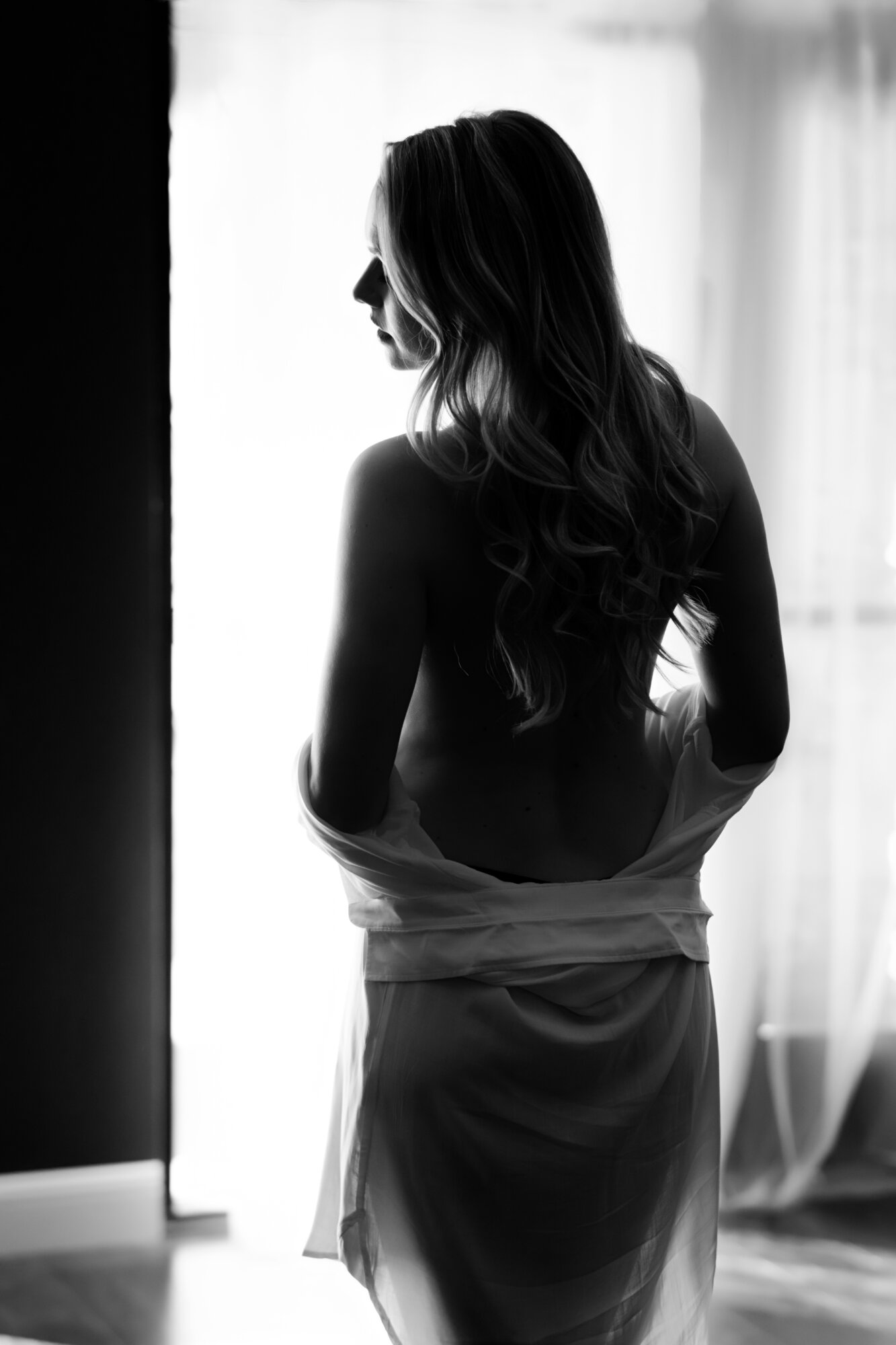
Most women arrive holding their bodies the way people hold their bodies when they expect to be evaluated, shoulders slightly raised, stomach pulled in, chin angled to hide whatever they’ve decided needs hiding. That posture is armor. It’s also the single biggest obstacle to a photograph that actually feels like something, because a body that’s bracing reads as bracing, no matter how good the lighting is.
So before we ever pick up a camera, we breathe.
Why bracing ruins a photograph before it's even taken
You can direct someone into a technically flattering pose and still end up with an image that feels hollow, because the body underneath the pose is tense. Tension shows. It shows in the jaw, in the shoulders, in the way a hand grips instead of rests. No amount of posing instruction fixes that. Only the body itself, given permission to actually settle, fixes that.
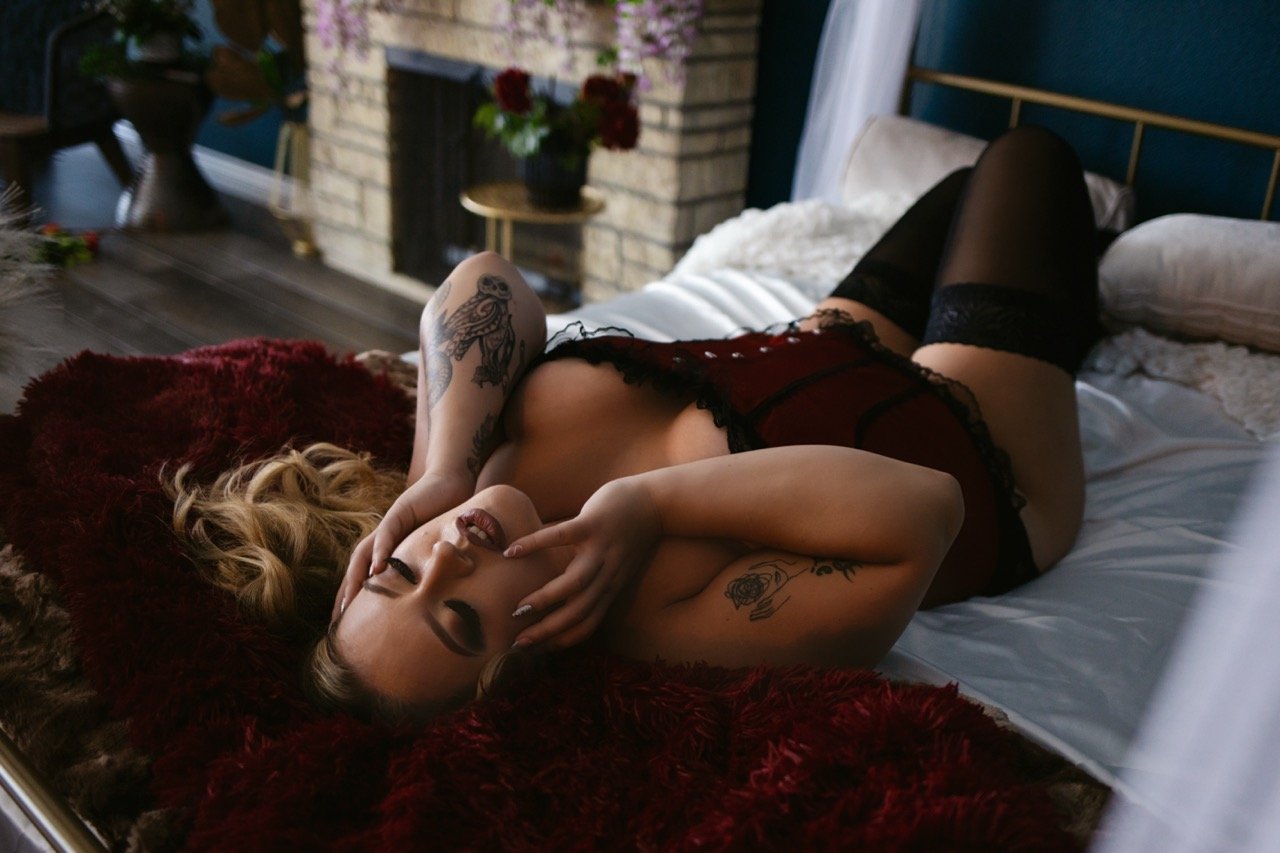
Breathwork is how that permission gets communicated. A slow, deliberate inhale and exhale, repeated a few times, guided, unhurried, does something posing instructions alone cannot. It moves a woman out of performance mode and into presence. The shoulders drop half an inch. The jaw unclenches. The stomach stops being pulled taut. None of that is about looking a certain way. It’s a physiological shift, and the camera sees it instantly.
The goal was never to feel fearless
I want to be clear about something: breathwork doesn’t erase nerves. Almost no one walks into a boudoir session feeling entirely at ease, and I’d be lying if I promised otherwise. What breathwork actually does is smaller and more honest, it gives your body somewhere to put the nervous energy besides bracing. That’s the whole goal. Not fearlessness. Just enough softness for the real you to show up in the frame instead of the version of you standing guard.
How this shows up throughout the session, not just at the start
Breath isn’t a five-minute warmup I do once and abandon. It’s woven through the entire session. Between poses, when I notice shoulders creeping back up toward the ears, we breathe again. When a transition feels rushed or a client’s energy shifts, we slow down and breathe again. It’s a tool I return to constantly, the same way a director might call for a beat of silence before a difficult scene, not because something’s wrong, but because presence needs room to arrive.
What this looks like from the outside
If you watched a session from the sidelines, you’d notice long pauses that might look, at first, like nothing is happening. That’s usually the most important part of the whole shoot. A woman standing quietly, eyes closed, breathing, while I wait, not because I’m behind schedule, but because rushing that moment would cost us the entire image that comes after it.
A simple technique you can practice before session day
You don’t need any special training to prepare. In the days leading up to your session, try this: inhale slowly for a count of four, hold for four, exhale for a count of six. Repeat it five or six times, somewhere quiet, ideally in front of a mirror so you can watch what happens to your shoulders and jaw as you do it. Most women are startled by how much tension they’re holding without realizing it. That awareness alone, noticing where your body defaults to bracing, makes the guided breathwork in the studio land faster and more naturally, because you’ve already met that tension once before.
Why this isn't just a wellness buzzword
I want to be careful here, because breathwork gets thrown around a lot in ways that can feel hollow or performative. This isn’t about chanting or incense or anything that would feel out of place in a photography studio. It’s a practical, physiological tool, slower breathing genuinely lowers heart rate and visibly softens the body, and a softened body simply photographs better than a tense one. That’s the entire justification. Not mysticism. Just what actually works.
I bring this up because some women feel a little self-conscious about the breathing portion of a session, as though it’s an unnecessary detour before the “real” photography starts. It isn’t a detour. It’s the foundation everything else is built on, and skipping it in favor of jumping straight to poses is exactly how you end up with a gallery full of technically fine images that don’t actually feel like anything.
Why this matters more than technical posing skill
Anyone can learn posing mechanics. What separates a session that feels alive from one that feels stiff is almost never the angle of a hip or the tilt of a chin. It’s whether the body in front of the camera has actually settled into itself. Breathwork is how I get there, every time, with every woman, regardless of how much posing experience she walks in with, which for most women is none at all, and that’s exactly as it should be.
The chapter this preserves
A photograph taken from a body that’s finally exhaled looks entirely different from one taken from a body still holding its breath. One documents a pose. The other preserves a moment. That difference is the entire reason breathwork comes first, every single time.
I’ve watched this shift happen in real time more times than I can count, a woman arrives rigid, apologizing before she’s even changed, and forty minutes later, after enough slow breathing and enough patience, something in her posture simply lets go. It’s not dramatic. It’s not a movie moment. It’s quiet, almost imperceptible if you’re not watching for it. But it’s the difference between a gallery that looks posed and one that looks alive.
Some women tell me afterward that the breathing exercises were the part they remember most clearly, more than any individual pose or outfit change. That doesn’t surprise me. A single held breath, released slowly and deliberately, is one of the few tools available to us for moving out of our own head and back into our own body, which, when you strip everything else away, is the entire point of a session like this.
If the idea of a session guided this intentionally speaks to you, let’s start with a conversation. Book your consultation and I’ll walk you through exactly how this works, from the first breath to the final frame.
+ view the comments